Published Date:
27 October 2006
By CLAIRE SMITH
WHEN he caught sight of the bright red pentagon glowing above the great rose window of Rosslyn Chapel, Alan Butler almost let out a scream. At that point, he knew beyond doubt that Rosslyn was far more than just another medieval church.
By rediscovering the lightbox, forgotten for hundreds of years, Butler and John Ritchie, co-author of Rosslyn Revealed, moved closer to illuminating their theory that the truth about the chapel is even stranger than the fiction made world-famous by Dan Brown.
"It was a real Indiana Jones moment," recalls Ritchie. "Older inhabitants of Roslin village had told the story of a mysterious light which appeared in the chapel on St Matthew's Day [21 September]. But the story had been ignored by successive histories of the chapel."
While some eagle-eyed guides in the chapel had spotted the tiny window at the top of the east wall, few bothered to point it out to visitors. The tale of how Ritchie and Butler rediscovered the hidden lightbox and why it was key to understanding the chapel's secrets is told in Rosslyn Revealed, out today.
It all began when Ritchie, a resident of Roslin who has had a lifelong fascination with the chapel, discovered an old Victorian print of Rosslyn by Hill and Adamson. Taken in 1844, it shows the East wall before the Rose window was built. When he showed it to Nancy Bruce, a guide in the chapel and his second cousin, she pointed out the aperture above the window and said: "That must be where the light comes through on St Matthew's Day."
Ritchie, a former Reuters cameraman, trained a telephoto lens on the tiny opening and discovered it was in the shape of a pentagon and appeared to be lined with some sort of highly reflective material. He explains: "I thought 'we have got to test this' and went to buy a power torch." Thanks to the scaffolding currently built around the chapel to dry it out after disastrous renovation work, he was able to climb up and shine the torch through the aperture, while Butler stood in the centre aisle to see the effect. In the book, the authors describe what happened next: "At most, we expected a small glimmer of white light from the lamp to show above the East window in the comparative gloom of the chapel's interior, but we couldn't have been more wrong. Instead of the faint glimmer we had expected to appear in the lightbox, what met our eyes was a perfect orb of steady, strong, blood-red light."
Butler struggled to conceal his excitement from other visitors in the chapel, which included a Chinese film crew. "We were absolutely stunned. I made such a loud exclamation that my wife Kate, who was with me, had to shut me up. We knew at that moment that it had been deliberately created to do this and that the people who built this church were not Christians in the accepted sense of the word." The discovery delayed publication of the book until the authors had explored the implications of the mysterious lightbox. Without erecting scaffolding inside the chapel, it was not possible to get close enough to the window to find out exactly what the box was made of. Ritchie believes the red light may come from a precious gem and that the reflective sides of the pentagon are made from highly reflective mica. The shape is significant; the pentagon or its close friend, the pentagram, or five-pointed star, is a common feature in ancient civilisations - and an important symbol in Freemasonry. Many associate it with magic or satanic rituals, but it was once widely used as a symbol of Christianity, with the five corners representing the five wounds of Christ. By recreating a scale model using Perspex and mirrors, the authors managed to demonstrate that the pentagonal lightbox creates a red doughnut of light, which at a certain angle refines itself into a beam of pure white light. On 21 September, the book was at the printers, but Ritchie and Butler returned to the chapel to see if St Matthew's Light still shone in the chapel.
The pair and a few guides gathered at the back of the chapel in the early morning to see if the lightbox was still functioning. Even on a dim Autumn day, the group of witnesses saw the pentagon glowing with a strong red light. "I was absolutely stunned," says Butler. "I had to pinch myself; I thought I was having a dream. People don't find these sorts of things."
The discovery shed new light on another unusual feature of the chapel. While most medieval churches were built facing east, the precise direction was determined by the day the sun rose on the relevant saint's day [the saint to which the church was dedicated]. Rosslyn was built facing due east, although it was completed before the existence of accurate compasses.
And there was more. The position of the secret window meant the light shone through on just two days of the year - 21 March, the first day of spring, and 21 September, the autumn equinox, or beginning of winter. Ritchie says: "It is so exact that if it had been an inch either way, this phenomenon would not have happened on the day it does. That shows exactly how Rosslyn was built."
Ritchie believes the lightbox was partly obscured by the rose window created in 1871 but that before this it would have created a light which illuminated a certain point on the chapel floor. A similar phenomenon can be found at St Sulpice in Paris [also featured in The Da Vinci Code], where a light reflects along the Paris meridian at midsummer, and Chartres Cathedral. The mysterious church of Rennes le Château, source of the Templar controversy, has dancing blue lights, which appear in January.
Ritchie also believes the light also has a correlation with the chapel's founder William Sinclair, whose name translates as Holy Light.
For Butler, an expert on stone circles, megalithic structures and astro-archeology, the discovery of the lightbox is confirmation the chapel's roots are in beliefs which predated Christianity by thousands of years. Both authors believe the rediscovery of the lightbox is a key to unlocking the true meaning of Rosslyn Chapel. Butler says: "In a way, this goes back to pre-Christian beliefs, to sun worship. It shows Rosslyn is unlike any other church in the world - in effect it is a medieval stone circle."
The full significance of the way Rosslyn was aligned on a true east-west axis before the existence of accurate compasses has still to be explored - but it fits with Ritchie and Butler's belief that Gilbert Haye and William Sinclair, who built the chapel, were masters of astrology. Unlike any other church, the inside of Rosslyn Chapel was once fitted with shutters, suggesting it may have been used as a secret observatory.
The authors also believe the foundation stone for the chapel was laid on the day of a rare conjunction between Venus and the Sun which is associated with the Shekinah, the female aspect of God. The hidden window may have been used as a way of measuring the movements of the planets, particularly of Venus. And, if the authors' experiments are correct, the light the secret window projected on to the back of the chapel casts a shape remarkably similar to the Eye of Horus, the all-seeing symbol of Freemasonry.
Even a person looking at Rosslyn Chapel with an untrained eye can see aspects unusual for a Christian church. The roof is sprinkled with roses and stars, and there are more Green Men - symbols of paganism - than any other church in the world. Carvings in the chapel encompass symbols of Judaism, Hinduism, Islam - and encompass the nature and sun worship of the earliest human religions.
The authors are certain there is much more to discover about the secrets of chapel. After almost a decade of research for the book, Ritchie says: "We feel as if we have only written the introduction."
• Rosslyn Revealed by Alan Butler and John Ritchie is published by O Books at £19.95.
Ebionites who harboured a Pope's son
THE conventional story of Rosslyn Chapel says Earl William Sinclair created it in the woods to thank God for a long and prosperous life. But John Ritchie and Alan Butler believe Gilbert Hay, listed in histories as "tutor to the Sinclair children," was key to the creation of the chapel.
The authors believe Sinclair and Hay were Ebionites, followers of a pre-Christian mystery tradition which had survived since biblical times.
Previously, Hay had been an adviser at the French court, personally knighted by the King of France and a confidant of French duke Rene D'Anjou. Hay was one of the most educated men in Europe and, while at Rosslyn, assembled one of the world's great libraries.
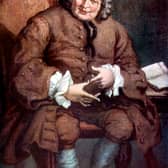
Ritchie and Butler believe Hay's real motive in settling at Rosslyn was to supervise the building of the chapel, which, far from being a conventional Christian church, enshrined the beliefs of the Ebionite sect. The Ebionites, who denied the divinity of Jesus and exalted John the Baptist, were persecuted and outlawed under the Inquisition. But they still had powerful friends, including Pope Pius II, below, who before becoming pontiff travelled on a secret mission to Scotland.
As a diplomat, the future pope fathered an illegitimate child, which, according to expert historians, he left with Sinclair to raise as his own.
Having friends in high places was just one of the reasons Sinclair and Hay were left alone to fill their chapel with symbolism wildly different from that of the orthodox Christian Church.
As Ebionites, their beliefs were a fusion of Pantheism, Persian dualism and Judaism. The feminine principle was acknowledged alongside the masculine and the individual was encouraged to have his or her own experience of God.
Look around Rosslyn Chapel and the evidence is there, in the carvings of feminine symbols of roses, in the portrayals of the Veil of Veronica, the Virgin Mary and Mary Magdalene.
In Rosslyn Revealed, Ritchie and Butler argue the Sinclair family, who are often taken to have been Knights Templar, were, in fact, Ebionites.
They ask: "Could it be possible Earl William Sinclair was a member of a family that had maintained its Ebionite, Jewish roots across 1,400 years of history?"
The evidence presented by Rosslyn Chapel seemed to indicate this could indeed be the case.
Factfile
• Rosslyn Chapel was built between 1456 and 1496. Master masons came from all over the world to build it.
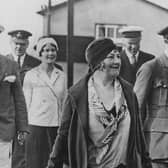
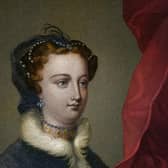
• The chapel has attracted some illustrious visitors over the years, including Sir Walter Scott, Dorothy Wordsworth, Queen Victoria, Robert Burns, Samuel Johnson, JMW Turner and Mary Queen of Scots. More recently, Michael Bentine, one of the original Goons, was a great enthusiast. He was a keen dowser and convinced Rosslyn was the centre of an unusually strong energy field. Rosslyn Revealed is dedicated to Bentine, below, while another unlikely expert is Rat Scabies, drummer with punk band The Damned. He wrote Rat Scabies and the Holy Grail with a journalist friend.
• In the 1560s a mob fuelled by John Knox and hatred of idolatry marched on the chapel to destroy it, but it was saved by local man Thomas Cochrane, who diverted the mob to Rosslyn Castle and its cellars of fine wine.
• The restoration in 1871 by the 4th Earl of Rosslyn was inspired by Queen Victoria. She was seduced by the chapel and appalled by its state of disrepair.
• The chapel is covered by a canopy and scaffolding, a result of disastrous repair work in the 50s. The inside of the chapel was coated in cement and became waterlogged. Rosslyn Chapel Trust, chaired by the current Earl, has applied for £11m of public money to restore the chapel.
• Some claim to have counted 110 green men in the chapel, as well as one highly unusual green woman. The men of the woods, with foliage emerging from the corners of their mouths, are an ancient symbol of man's interdependence with the natural world, and are also found in Hinduism.
• In The Lay of the Last Minstrel, Sir Walter Scott told the legend of the glowing red light which is said to emanate from the chapel when one of the Sinclairs is close to death. "O'er Roslin all that dreary night, a wondrous blaze was seen to gleam; 'twas broader than the watch-fire's light, And redder than the bright moonbeam."
The full article contains 2122 words and appears in The Scotsman newspaper.
-
Last Updated:
27 October 2006 8:51 AM
-
Source:
The Scotsman
-
Location:
Edinburgh
-
Related Topics:
Rosslyn Chapel